

If you’ve spent any time in the trenches of modern IT operations, you know that configuration management isn't just a luxury anymore; it’s the backbone of your infrastructure.
When evaluating the "Big Four" configuration management tools: the Progress Chef solution, Puppet, Ansible and SaltStack; the conversation often devolves into heated wars over syntax and architecture. Ansible gets praised for its YAML learning curve, Puppet for its sysadmin-friendly declarative models and SaltStack for its high-speed event-driven execution.
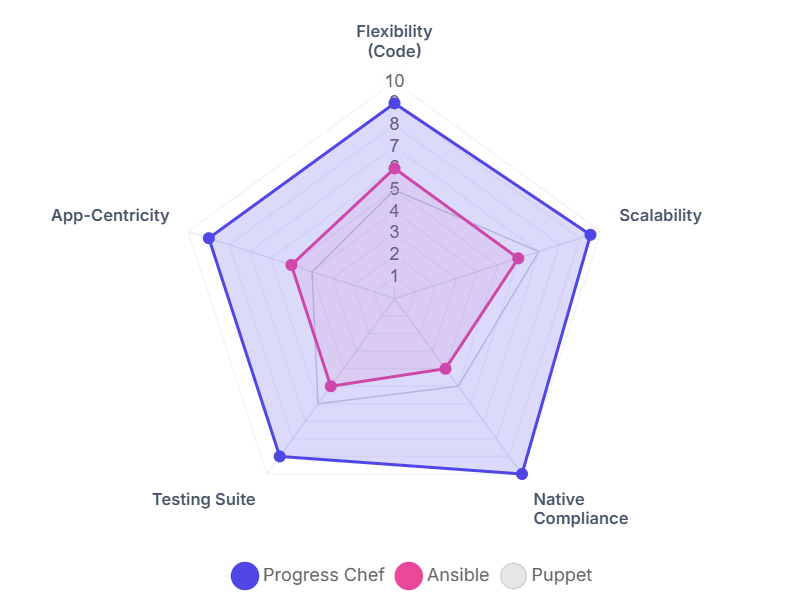
Progress Chef, Ansible, Puppet and SaltStack are four widely used tools for automating infrastructure and configuration management. Chef distinguishes itself with its strong programmability, mature testing ecosystem, built‑in compliance capabilities, and ability to scale reliably across complex enterprise environments.
Here's a tabular comparison:
Progress Chef vs Ansible vs Puppet vs SaltStack: Comparison and Key Differences
| Criteria | Progress Chef | Ansible | Puppet | SaltStack |
|---|---|---|---|---|
| Configuration Model | Policy‑as‑Code with Ruby DSL and YAML support | YAML‑based playbooks | Proprietary declarative DSL | YAML with Jinja and Python |
| Architecture | Agent‑based (with agentless options) and pull‑based | Agentless and push‑based | Agent‑based and pull‑based | Agent‑based with optional agentless mode |
| Handling Complex Logic | Strong support for conditionals, loops, and custom logic | Limited to advanced logic beyond YAML | Structured but less flexible than full programming | Moderate flexibility using Python and templates |
| Testing and Validation | Built‑in test‑driven automation (Test Kitchen, InSpec) | Limited native testing capabilities | Basic testing through external tools | Limited built‑in testing |
| Compliance and Security | Integrated compliance and policy enforcement | Relies on external tools for compliance | Compliance support is available in enterprise editions | Compliance requires additional setup |
| Enterprise ROI Focus | Optimized for long‑term ROI through reduced drift and technical debt | Faster initial adoption, lower upfront complexity | Strong governance but higher operational overhead | Performance‑focused rather than ROI‑driven |
| Ideal Use Case | Enterprises needing scalability, compliance, and customization | Teams prioritizing speed and simplicity | Organizations favoring declarative governance | Environments needing real‑time, event‑driven control |
But, what happens when these tools have to work within complex enterprise environments, true ‘Infrastructure as Code’ and measurable Return on Investment, which justifies the investment?
Today, we are taking a hard look at the data and the trenches. Here are the six core areas where the Chef solution can outperform its competitors, and how that translates into massive ROI for your organization.
1. True Programmability and Flexibility: The Power of Choice
The Competition: Ansible relies heavily on YAML. While YAML is incredibly easy to read and great for simple playbooks, it is, at the end of the day, a data serialization language, not a programming language. When your infrastructure logic gets complex (think dynamic variables, conditional loops and deep integrations), YAML becomes a messy, unwieldy nightmare. Puppet uses its own proprietary declarative DSL, which is notoriously rigid, while Salt uses a mix of YAML and Jinja templates.
The Chef Advantage: The Chef solution doesn’t lock you into a single paradigm. It provides you with the flexibility to choose your language based on your requirements. For simple, declarative configurations, the Chef solution fully supports YAML, making it just as approachable for beginners as its competitors. However, when you hit the limitations of YAML, the Chef solution provides a seamless escape hatch: a robust Domain-Specific Language (DSL) backed by Ruby. This dual-approach means you get simplicity when you want it and actual, fully-fledged code when complexity demands it. Developers can use standard programming constructs, object-oriented logic and for more complex tasks, tap into the massive ecosystem of existing Ruby libraries to solve almost any infrastructure problem imaginable.
The ROI Impact:
- Developer Productivity: By allowing teams to start simple with YAML and scale up to a real programming language, Chef bridges the gap between Dev and Ops. Teams don't have to hack together workarounds in massive YAML files; they write clean, testable code. Thereby increasing developer productivity and faster turnarounds.
- Reduced Technical Debt: Complex architectures can be modeled elegantly, reducing the time spent rewriting clunky scripts and saving thousands of engineering hours annually.
2. Unmatched Testing Ecosystem
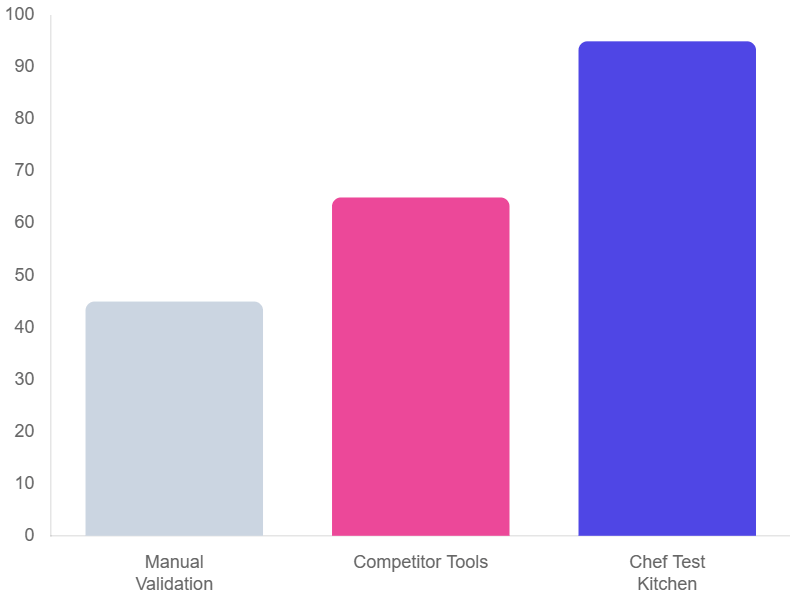
The Competition: How do you test an Ansible playbook or a Puppet manifest before pushing it? Often, the answer is a combination of dry runs, spinning up manual test VMs or crossing your fingers and hoping for the best. The testing ecosystems for Chef competitors are often bolt-on afterthoughts or rely heavily on third-party integrations that lack deep native support.
The Chef Advantage: Chef pioneered test-driven infrastructure. With Test Kitchen (alongside Cookstyle and ChefSpec), testing is a first-class citizen in the Chef world. Test Kitchen automatically spins up isolated environments (via Docker, Vagrant or cloud providers), applies your Chef recipes, runs compliance tests and then destroys the environment.
The ROI Impact:
- Zero-Downtime Deployments: "Testing in production" costs organizations millions in downtime and lost revenue. The Chef-native testing pipeline catches misconfigurations before they hit production.
- Faster Release Cycles: Because engineers have high confidence in their code, approval processes are shortened, allowing companies to push features and fixes to market much faster than competitors relying on manual testing.
3. Native Compliance-as-Code
The Competition: Puppet, Ansible and SaltStack are primarily configuration management tools. If you want to run security audits or compliance checks, you usually have to integrate them with external vulnerability scanners or write custom, fragile scripts to check server states against CIS benchmarks.
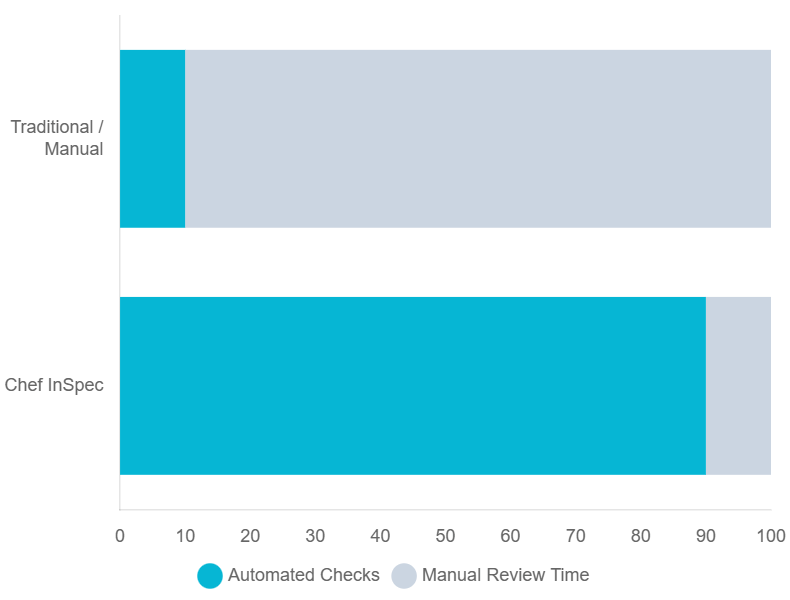
The Chef Advantage: Chef offers Chef InSpec, an open-source framework designed for testing and auditing applications and infrastructure. InSpec lets you write compliance and security rules in human-readable code. It integrates directly into your deployment pipeline, enabling that a server cannot be deployed unless it passes every security policy (HIPAA, PCI-DSS, SOC2, etc.).
The ROI Impact:
- Audit Readiness: Instead of spending weeks pulling logs and manually verifying server states for auditors, InSpec provides continuous, automated compliance dashboards.
- Risk Mitigation: By shifting security entirely to the left, you drastically reduce the risk of a catastrophic data breach caused by a misconfigured server, protecting your brand reputation and saving millions in potential fines.
4. Application-Centric Automation
The Competition: Ansible, Puppet and SaltStack are fundamentally infrastructure-centric. They care about the server, the OS and the system packages. But what about the applications that serve your business?
The Chef Advantage: The Chef development team saw the writing on the wall and built Chef Habitat. Habitat flips the script by packaging the automation with the application. The app travels with its own dependencies and configuration instructions, making it completely agnostic to the underlying infrastructure. Whether you deploy it to bare metal, a VMware VM or a Kubernetes pod, the application knows how to run, configure and update itself.
The ROI Impact:
- Seamless Cloud Migration: Habitat eliminates the "works on my machine" problem. Because the app carries its own environment, organizations can lift-and-shift legacy apps to the cloud or Kubernetes with a fraction of the usual refactoring cost.
- Future-Proofing: You aren't locked into a specific cloud vendor or orchestrator, giving the business the agility to pivot infrastructure strategies without rewriting deployment scripts.
5. Enterprise Scalability via Autonomous Pull Architecture
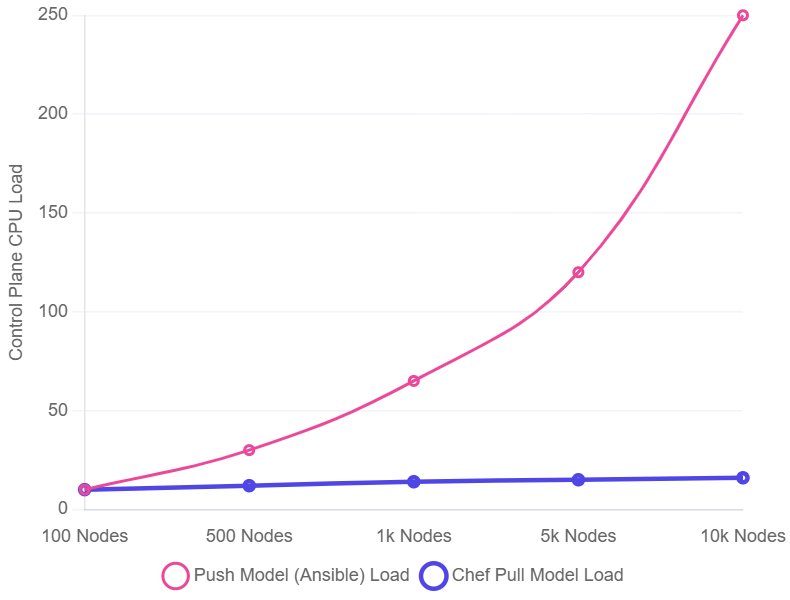
The Competition: Ansible’s default architecture is push-based and agentless (via SSH). While great for quick startups, pushing configurations to 10,000+ nodes simultaneously via SSH creates massive network bottlenecks and control-plane CPU spikes. SaltStack handles scale better but requires managing a complex Master-Minion topology. Puppet's catalog compilation can also severely tax the Puppet Master at scale.
The Chef Advantage: The Chef solution uses a highly decentralized pull architecture. The Chef Server acts as a lightweight repository. The heavy lifting is done by the Chef Client sitting on the target node. The client periodically wakes up, pulls the latest policy from the server, calculates what needs to change and enforces it locally.
The ROI Impact:
- Infinite Scalability with Lower Cloud Bills: Because the computation happens at the edge (on the nodes themselves), the central Chef Server requires significantly less compute power compared to push-based orchestrators.
- Self-Healing Infrastructure: If a node goes offline or experiences configuration drift, it automatically corrects itself the next time it checks in, drastically reducing the volume of late-night Pager Duty alerts and freeing up Ops teams for high-value strategic work.
6. Tool Consolidation: Bridging the Gap with the Chef 360 Platform
The Competition: Organizations frequently suffer from "tool sprawl." A network team might adopt Ansible for its robust networking modules, while the core infrastructure team uses a different tool. Managing multiple orchestrators leads to duplicated effort, fragmented visibility and bloated licensing costs. Competitors often force a "rip and replace" mentality to achieve a unified workflow.
The Chef Advantage: Enter the Chef 360 platform, the latest evolution from the Chef team. The Chef 360 platform serves as a unified, enterprise-grade control plane that natively ingests and orchestrates Ansible workflows within the Chef ecosystem. You no longer must choose between the two or force your teams to abandon the playbooks they've spent years building.
The ROI Impact:
- Eliminate Tool Sprawl: Drastically reduce administrative overhead and consolidate your infrastructure management under a single pane of glass, cutting down on redundant enterprise licenses.
- Preserve Existing Investments: Don't throw away valuable engineering time. Bring your existing Ansible playbooks into Chef 360 and orchestrate them alongside your Chef recipes, unifying your Dev and Ops teams without losing momentum.
The Verdict: Why the C-Suite and Engineers Should Agree on Progress Chef
Ansible, Puppet and SaltStack demonstrate strengths in disparate ways.
But if your goal is to treat your infrastructure exactly like software, embed security directly into your pipelines and manage tens of thousands of nodes across hybrid clouds, the Chef platform is an ideal solution for your team. The myth that Chef is "too hard because of Ruby" is outdated. You can start simple with YAML, leverage the programmatic power of Ruby exactly when your infrastructure demands it and now, with the Chef 360 platform, even run your Ansible workflows natively. By reducing downtime, automating compliance and empowering developers with flexible coding constructs, the Chef platform transforms IT from a cost center into a high-velocity innovation engine.
To know more, request a trial today!
Frequently Asked Questions
What is the difference between Chef, Ansible, Puppet and SaltStack?
Chef stands out for its robust Infrastructure‑as‑Code model, using powerful Ruby‑based recipes to manage complex systems at scale. While Ansible focuses on simplicity and agentless execution, and Puppet and SaltStack offer declarative and event‑driven models, Chef excels where deep customization, testing, and long‑term state management are required. It is purpose‑built for enterprise‑grade automation.
Why do enterprises use Chef for infrastructure automation?
Enterprises choose Chef for its ability to automate large, hybrid environments with consistency, compliance, and control. Chef’s policy‑as‑code approach, test‑driven workflows, and strong governance capabilities make it ideal for regulated industries and mission‑critical systems. It helps organizations reduce configuration drift while scaling automation confidently.
Is Chef better than Ansible, SaltStack, and Puppet?
Chef is often the better choice for enterprises managing complex infrastructure, strict compliance requirements, and large fleets of nodes. Unlike simpler tools, Chef provides advanced testing, deep extensibility, and mature compliance automation. For organizations prioritizing reliability, scalability, and control, Chef offers clear advantages.
Which configuration management tool is best for DevOps?
For enterprise DevOps teams, Chef is a strong choice due to its seamless integration with CI/CD pipelines, Infrastructure‑as‑Code practices, and compliance automation. While other tools work well for lightweight or short‑term automation, Chef supports full‑lifecycle DevOps—from development and testing to production and audit readiness—at scale.

